
Prince Albert Daily Herald
Sage Hill Young Writers’ Workshop encourages Prince Albert youth to write

Sage Hill Young Writers’ Workshop encourages Prince Albert youth to write
By Lexi Saldaña – July 21, 2026
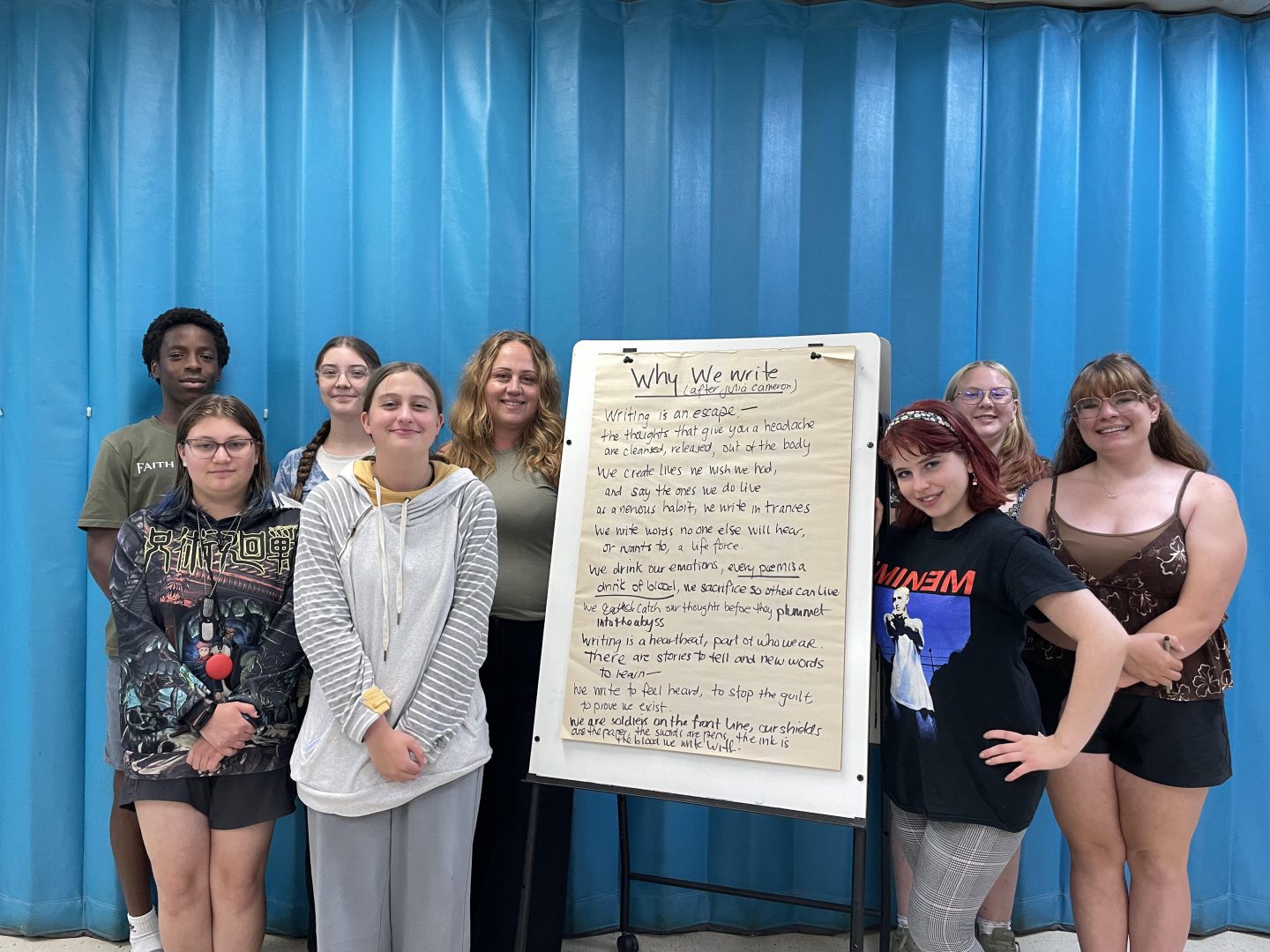
Until July 24, the John M. Cuelenaere Public Library will be hosting The Sage Hill Young Writers’ Workshop–a space for youth aged 11 to 15 to learn about writing as a craft and as a profession while being surrounded by like-minded peers.
Somatic therapist and workshop facilitator, Shauna Eveleigh Harris, said the program helps aspiring and casual writers alike to improve their skills through writing activities in various genres, and foster community by daily connection exercises. Harris adds that kids in this age group are closer to their imagination compared to those older.
“The fantasy world of the imagination is still really accessible. A lot of times as adults that goes away and you have to remember,” she said. “I think it’s more available to them–the belief that they can be artists.”
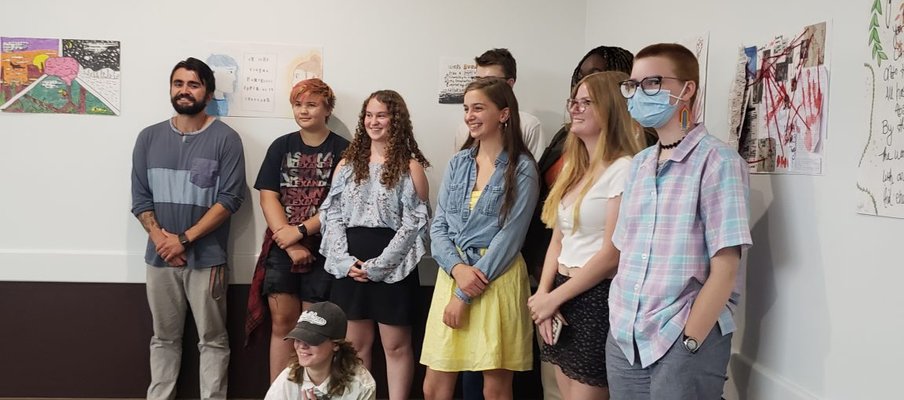
Shauna Eveleigh Harris with her Sage Hill Youth Writers’ program students.
— Lexi Saldana / Daily Herald
Harris’s social work and therapist background has enabled her to create a classroom that students feel comfortable in.
“It’s funny because some of the students today said that they feel like coming together in this group feels like group therapy and that writing is therapy,” she said. “A lot of them identify as neurodivergent and on the autism spectrum, so not only writing, but being together with other folks who identify as neurodivergent and on the spectrum is helpful to be with people who understand you.”
Aside from creating a community for youth to build confidence in their artistic writing, the program is also free to reduce financial barriers, made possible by a partnership with the Prince Albert Public Library and a variety of funders including the Prince Albert and Area Community Foundation, SK Arts, SaskCulture and Canada Council—allowing accessibility to a safe, constructive and educational environment.
“My intention for writing is for writing’s sake,” said Harris. “Writing’s a practice. Keep writing no matter what. So for me in particular, as a facilitator of this program, my intention is always say what you want to say. No good, no bad, just writing.”
Students of the program encourage those interested in participating to join, stating that the event is for learning, improving writing and making lifelong friends. Harris encourages parents to support their children’s work.
“Have them read it out loud to you and don’t comment,” she said. “I’m not saying be a blank screen, but as a parent, ask the writer, ‘What are you writing? Tell me more. Oh wow, where’d you get that idea?’ Let it be what it is, not everything has to be publishable.”
On July 24, the Sage Hill Young Writers’ Workshop will be hosting a reading event at the John M. Cuelenaere Public Library where youth can share their work with the public, and for the public to engage with their work.
Discover Humboldt
Humboldt Gallery, Sage Hill partner for public reading featuring Kevin Chong, Kristy Jackson

Humboldt Gallery, Sage Hill partner for public reading featuring Kevin Chong, Kristy Jackson
By Maury Wrubleski – May 15, 2026
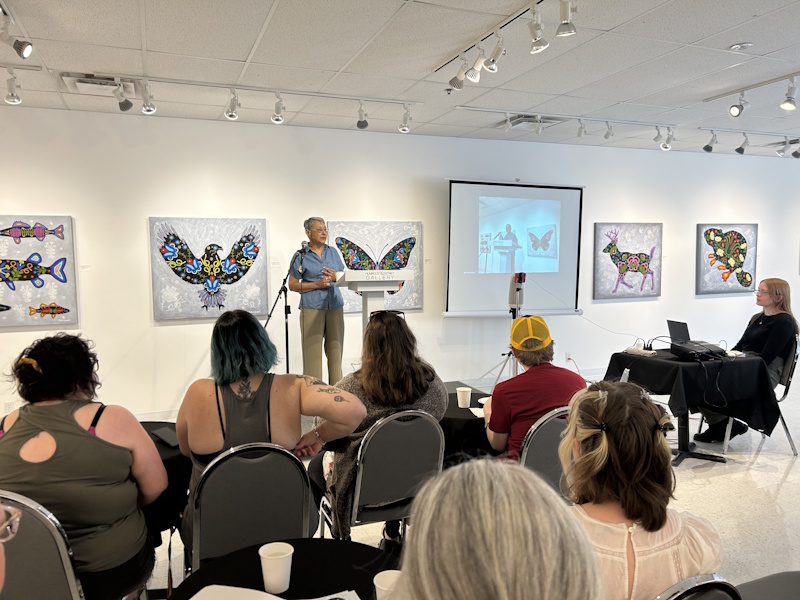
The Humboldt & District Gallery is partnering with Sage Hill Writing Experience to host an afternoon of literary readings and community storytelling featuring acclaimed Canadian authors and emerging local writers.
The event, scheduled as the finale to Sage Hill’s week-long fiction writing retreat at St. Peter’s College, will feature readings by Giller Prize finalist Kevin Chong and Saskatchewan Book Award finalist Kristy Jackson, followed by a public question-and-answer session and a community open mic.
Photo provided by Humboldt and District Gallery
Sage Hill’s annual retreat draws writers from across Canada to Muenster for intensive workshops and mentorship opportunities focused on developing fiction writing skills. Chong, an associate professor at UBC Okanagan and the author of seven books, is leading this year’s retreat.
His most recent novel, The Double Life of Benson Yu, was shortlisted for the 2023 Giller Prize and named one of CBC’s best Canadian fiction books of the year.
Jackson, who lives in Saskatoon, has received national recognition for her children’s and middle-grade fiction. Her debut novel Mortified was shortlisted for a Governor General’s Literary Award and a Saskatchewan Book Award, while her latest novel Touching Grass earned multiple honours, including three Saskatchewan Book Award nominations.
Organizers say the event is designed not only to showcase established literary voices, but also to create space for local writers and Sage Hill participants to share their own work.
Audience members attending in person or virtually will have the opportunity to participate in the community open mic, with readings limited to five minutes each. Organizers say the open mic portion of the afternoon will run for approximately 40 minutes, depending on participation.

The event will also be livestreamed through Zoom for virtual attendees and readers.
Registration for the livestream is available through Zoom registration page.
For additional information, organizers encourage the public to contact Jennifer Fitzpatrick at the Humboldt & District Gallery.
Prince Albert Daily Herald
Words take flight: Young writers workshop returns to P.A.
Words take flight: Young writers workshop returns to P.A.
By Arjun Pillai – July 21, 2025
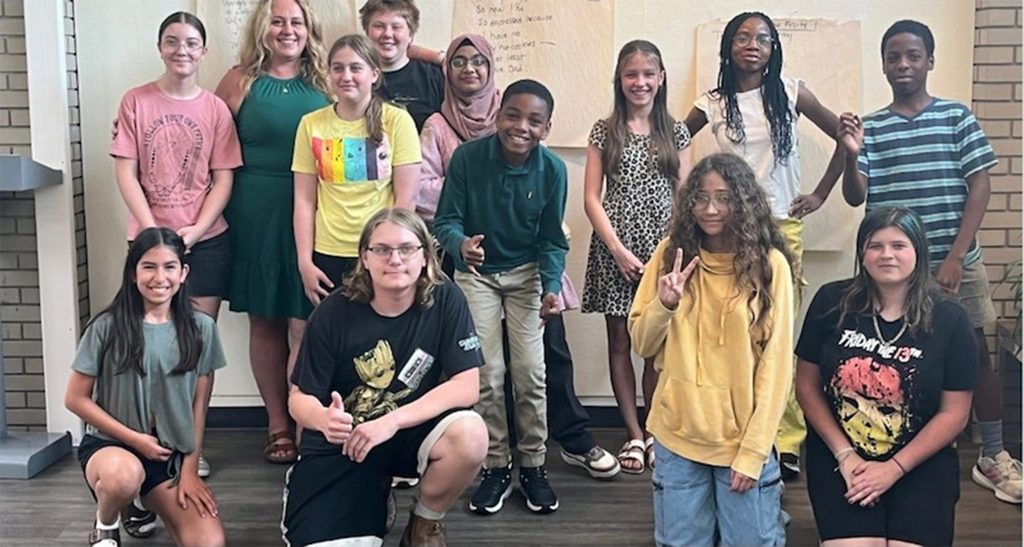
Young writers in Prince Albert will have the chance to sharpen their creative skills next week as the Sage Hill Youth Writer’s Workshop returns to the city.
Running from July 28 to August 1 at the John M. Cuellenaere Public Library, the five-day workshop is open to youth aged 11 to 15. Participants will explore fiction, poetry, editing techniques, and even sensory writing exercises outdoors, all under the guidance of professional local writers.
Sage Hill Writing Experience Facebook Photo. Sage Hill Prince Albert
Young Writers’ Workshop participants pose for a photo following the
last workshop in 2024. The 2025 workshop begins on July 28.
“This program helps young people not only improve their writing but also find a community of like-minded peers,” said Caitilin Terfloth, Acting Executive Director of Sage Hill Writing. “For many, it’s their first time meeting others who share their passion for writing.”
This year’s instructor is Prince Albert’s own Shauna Everleigh Harris, joined by guest writer Kerry Steen, a Sage Hill alumna. The combination offers students a chance to learn from multiple voices and perspectives.
“We want to meet each student wherever they are in their writing journey and help them move forward, whatever their goals are,” Terfloth added.
The program is free, thanks to community support.
“Many participants tell us they wouldn’t have been able to attend without the no-cost access,” she said. “It’s very important to us to remove financial barriers and make creative expression accessible.”
Past participants have gone on to study writing, communications, English, and journalism, with some entering national spoken word competitions or even becoming Saskatchewan’s Youth Poet Laureate.
“We’ve also heard from participants who didn’t choose writing as a career, but still tell us the program made a difference in their professional lives,” said Terfloth.
Applications have officially closed, but a few spots may still be available. Interested families can email to inquire.
The workshop wraps up with a public reading event on Friday, August 1, at 12 p.m. at the library, often the first time students share their work outside the classroom.
For more details, visit sagehillwriting.ca.
Discover Humboldt
Marilyn Dumont shares insights into Sage Hill Poetry Colloquium at St. Peter’s Abbey
Marilyn Dumont shares insights into Sage Hill Poetry Colloquium at St. Peter’s Abbey
By Maury Wrubleski – Friday, May 23 2025
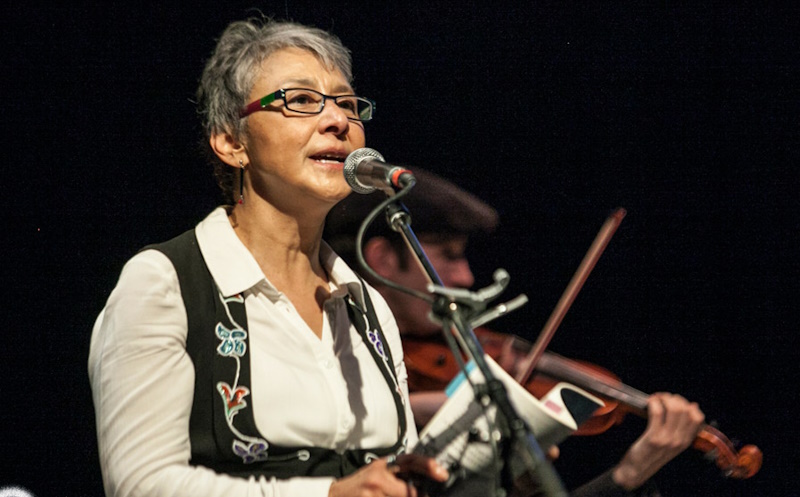
A group of accomplished writers from across Canada is gathered at St. Peter’s Abbey for a special collaborative writing experience to help refine works in progress or spark the flame of new collections. The Sage Hill Writing Spring Colloquium is led by renowned Canadian Métis poet Marilyn Dumont at the Abbeys’ retreat centre.
Sage Hill Writing takes its name from the first location where it gathered writers in a retreat setting at the one-time Sage Hill Centre, the former Air Force facility near Dana. Since then, the program has set up residence in various retreat centres, mostly rural, to allow writers to gather and focus on their work. St. Peter’s Abbey has been one of those inviting locations says Acting Executive Director Caitlin Terfloth.
“It’s a very important place for us to come to particularly with the closure of other retreat venue options,” says Terfloth. “We’re looking for a place where writers can really be at home and have all the facilities and amenities they have here, and at a rate that artists can typically afford.”
It’s in this idyllic natural centre that these seasoned writers have set up shop, many of whom are working on the finishing touches of poetry manuscripts. The collegial atmosphere has these poets reading each other’s work, meeting in workshop fashion, and considering published work as inspiration for new directions.
It’s all under the guidance of facilitator Marilyn Dumont, the 2018 recipient of the Lifetime Membership from the League of Canadian Poets for her storied contributions to the Canadian poetry scene. She’s produced four award winning collections of poetry and has released her newest, South Side of a Kinless River published by Brick Books, in 2024.
For her work, she draws on her family history and stories of Alberta Métis settlements which have been somewhat lost in the evolution of the country’s history. Her pull toward poetry was a natural function of her growing up, Dumont explains.
“Growing up as a teenager, I read poets, and it seemed to me I always went to them when I wanted to hear somebody tell the truth. I’ve always been drawn to poets; they seem to be my people in terms of where they position themselves in the world. Poets are quite often the canaries in the coal mine; they’re the ones speaking up about things that are maybe not spoken about.”
Whether it’s political strife, social injustice, or environmental degradation, poets house the proverbial watchtowers, she says.
Like any artist, Dumont’s work, by her own admission, has shifted from self-referential and narrative poetry to new avenues where she finds herself working in different ways. It’s simply a matter of progression through learning, experience, mistakes and the influences of other writers and thinkers. In a large sense, that’s the power of the colloquium – a type of experiential immersion in a condensed format.
“The poets we have here are very accomplished writers,” Dumont affirms. “They’re writers who have either published a book, or they have a chapbook. And they are people who read poetry. That seems to be critical in terms of writing poetry. We have to read other poets to learn from them what to do, what not to do. We have a very strong cohort of poets here working on diverse subject matter. It’s very exciting; I love it.”
That dedication and enthusiasm shows in the outcomes of each writer’s work, and it’s reflected through Marilyn’s spirit and approach to poetry. She speaks enthusiastically about the spoken orientation to poetry – the beauty in the sonics of a language. Poetry is best appreciated and supported as part of a community, and she asserts that there is a strong community of poets and poetry lovers in the country whose collegial values are important to the development of new work.
Marilyn will be reading alongside Sask Book Awards nominated Courtney Bates-Hardy at the Humboldt and District Gallery on Saturday afternoon at 2 pm.
“We have a new partnership we’ve just established with the Humboldt and District Museum who will be hosting this event,” explains Caitlin Terfloth. “It’s a great new partnership because we bring writers from all over Canada working with us, yet we haven’t had a lot of interaction with the community, and we know there is a writing community in Humboldt. So, I think this will be a great opportunity to get out there and meet with local writers.”
The event is free and open to the public. Join the Sage Hill Writing community as the Gallery welcomes Marilyn Dumont and Courtney Bates-Hardy.
Enjoy the full conversation with Caitlin Terfloth and Marilyn Dumont at the Discover Humboldt website
Marilyn Dumont, facilitator at the Sage Hill Spring Poetry Colloquium, will be reading alongside Courtney Bates-Hardy on Saturday at the Gallery.
SaskToday
Award-winning poets to join reading at Humboldt & District Gallery

Award-winning poets to join reading at Humboldt & District Gallery
By Nicole Goldsworthy – May 20, 2025
The Humboldt and District Gallery will host a public poetry event with Sage Hill Writing on May 24, featuring acclaimed poets.
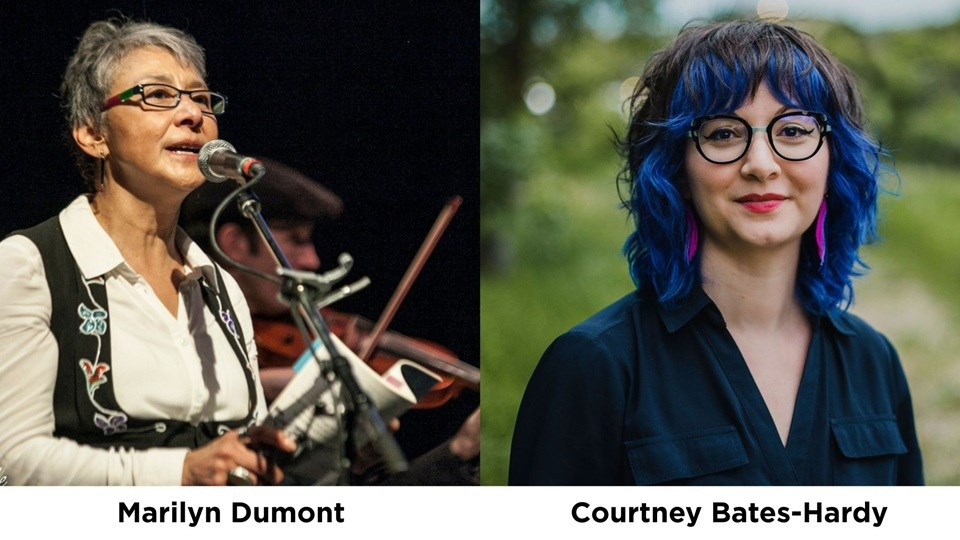
HUMBOLDT — The Humboldt and District Gallery, in partnership with Sage Hill Writing, is hosting a public event as part of Sage Hill’s spring poetry Colloquium on May 24 at 2 p.m.
The event will feature readings by award-winning poets Marilyn Dumont and Courtney Bates-Hardy.
“Marilyn Dumont will be leading Sage Hill Writing’s 2025 Spring Poetry Colloquium at St. Peter’s College, and Courtney Bates-Hardy is a shortlisted nominee for the 2025 Saskatchewan Book Awards,” said Rachel Wormsbecher, museum supervisor.
Poets Marilyn Dumont, left, and Courtney Bates-Hardy will be featured at
the Sage Hill Writing Spring Poetry Colloquium on May 24. Courtesy of
Humboldt & District Museum and Gallery
Following the readings, there will be a Q&A session and a community open mic. Both in-person and virtual attendees are welcome to participate.
“Open mic readings should be no longer than five minutes and can be in any format,” Wormsbecher said. “Anyone who wishes to read can sign up at the event.”
To follow along on zoom, click on the link to Zoom registration here.
Sage Hill Writing, based in Saskatchewan, is one of Canada’s leading learning opportunities for professional and emerging creative writers. Writers from across the country attend Sage Hill’s retreats to create, revise and develop new literary work, according to its website.
SaskCulture
Writing program a safe space for youth to explore and create

Writing program a safe space for youth to explore and create
By Ana Cristina Camacho – March, 2024
As a child, Warsha Mushtaq discovered a love for words and writing poetry. However, her involvement in a Sage Hill Youth Writing Workshop, instructed by writer Danica Lorer, is where she discovered her voice.
Mushtaq, the former Youth Poet Laureate, says, “To this day, I remember what she [Lorer] did for me and how encouraging she was. That guidance and mentorship, you couldn’t really get anywhere else. The amount of growth that happens in that space is just so phenomenal.”
Mushtaq, attended her first Sage Hill workshop the year she was finishing middle school. Like many of the young writers that attend the program, she became a repeat participant, coming back for the next three summers.
Tara Dawn Solheim, executive director, Sage Hill Writing, says that the organization’s youth programs offer young creative minds in the province tools and support to hone their skills. The workshops are led by published Saskatchewan writers, giving participants access to personalized professional mentorship, free of cost.
“Students who are interested in creative writing might not find support in their school, but they can find support through us and through the community that they build with the other students,” says Solheim.
“For youth, getting to contribute to the cultural vibrancy of their community and using their voices is a really important thing.”
Solheim says that every year, when she goes in to welcome the participants on the first day of the youth workshops, she sees a lot of shy faces. Five days later, when she listens to them read their work in front of their friends and families, she can see “how much they’ve grown, the bonds that they’ve made, and how much the writing has improved.”
Mushtaq adds, that the supportive environment created by the writing instructors is one of the reasons why the young participants feel empowered to learn and be creative in the Sage Hill workshops.
“In every group I had, everyone was so willing to share their ideas and share their passion for writing,” she says. “I think that in a regular classroom setting, sometimes we don’t really connect. But this summer program was just a very safe space. There was no judgment, so we were all really willing to take risks with our work.”
One of her favourite memories at the Sage Hill workshops was the reading events at the end of the program. She explains how she worked on a piece about Islamophobia for one of her readings and how getting to write about her identity in a safe environment changed her. “It made me a much more confident person. It felt cathartic for me to have that presentation and to have all the writers around me support me as I presented that poem. I think that after that poem, I grew.”
Now a history student at the University of Saskatchewan, Mushtaq has many goals for her writing because of her Sage Hill experience, such as being part of writing festivals, publishing more poems, publishing a book. “I came into that program as a very shy writer. I came in kind of unsure. But by the end, I had realized that art is very diverse, and it is not just for one type of person. If I genuinely want to keep doing this, I don’t have to feel like it’s impossible.”
Sage Hill’s programs are supported by operating funding from the Professional Arts Organization Program (PAOP) through SK Arts supported by funding from Sask Lotteries through the partnership between SK Arts and SaskCulture.
SaskLotteries
Sage Hill Writing authors homegrown success story

Sage Hill Writing authors homegrown success story
Written by Ryan Flaherty for Sask Lotteries – 2024
When the Saskatchewan School of the Arts closed its doors in 1989, it left a void in the province’s creative landscape, but thanks to a dedicated group of writers the spirit of that artistic hub lives on through Sage Hill Writing, which marks its 35th anniversary this year.
Sage Hill’s mission is simple: to provide opportunities for writers of all experience levels to hone their craft with the help of other writers through an assortment of retreats, programs and other events.
What began as a mere five days of courses in 1990 has since grown into a full slate of programming, drawing writers not only from Saskatchewan but across Canada. Some are just setting out on their writing journey while others come seeking inspiration, feedback and support for their work from fellow members of the writing community.
“Writing is often a solitary action. Through Sage Hill, writers form life-long community bonds and often return to work on new projects.”
Tara Dawn Solheim, Executive Director
A typical Sage Hill course includes three main elements: group sessions for sharing ideas and techniques, one-on-one feedback with instructors, and personal writing time. There are also publishing workshops, tips on grant writing and even sessions dedicated to mental and physical health. The courses are led by experienced writers, with literary heavyweights like Jane Urquhart, Lorna Crozier and Guy Vanderhaeghe among those who have served on the faculty over the years.
The proof of concept is on the bookshelves. Roughly 850 works have been published by writers after they participated in a Sage Hill retreat, and the list of notable alumni includes best-selling novelist Lisa Moore, Griffin Prize-winning poet Sylvia Legris and several Saskatchewan Book Award winners.
But Sage Hill isn’t just focused on getting things published. It’s also intent on helping the next generation of writers find their voice through an assortment of youth workshops. Thanks to the support of funding partners like Sask Lotteries, these workshops are available free of charge, reducing barriers to participation and providing opportunities for young writers from a diversity of backgrounds to find a community. In recent years, the addition of online programs has allowed for even greater accessibility.
“It has been amazing to watch the community blossom with the mix of virtual and in-person programming,” Solheim said.
And while the writers themselves enjoy the direct benefits of enrolling in a Sage Hill program or workshop, the ripple effects extend well beyond that.
“Sage Hill’s programs provide a supportive and educational environment to help writers find and trust in their own voices. The voices of these writers in turn contribute to the cultural vibrancy of our Saskatchewan community,” Solheim said.
It’s a homegrown success story with many chapters yet to be written.
SaskToday
Sage Hill Writing accepting applications for free workshops

Sage Hill Writing accepting applications for free workshops
Program presents free-of-charge mentorship for young writers in Saskatchewan
Jun 7, 2022

SASKATCHEWAN — Sage Hill Writing has opened applications to local writers ages 11 to 18 for the 2022 Teen & Young Writers’ Workshops. The workshops will be facilitated by experienced writersand featured guest authors throughout the province this summer, through online delivery.
Sage Hill continues a 33-year mission to support the development of the next generation of Saskatchewan writers with this yearly program. This summer, the creative young writers of the province can access these free-of-charge writing workshops where they can develop their skills with professional writers. The online workshops are open to applicants from any location.
Creative young writers can access free-of-charge writing workshops where
they can develop their skills with professional writers. | Anna
Gorbacheva/iStock/Getty Images Plus
The Teen & Young Writers’ Workshops are designed to encourage the growth and development of students who want to connect with the local and online writing community and learn about writing as a craft and a profession. The successful applicants will be guided through writing activities in various genres, and they will have the opportunity to discuss with instructors the writing life, professional pathways, and publication. Interested young writers can apply online at https://sagehillwriting.ca/youth-workshops/.
Sage Hill Writing is a nonprofit organization with a long history of fostering Saskatchewan’s writing community. Students of the youth programs consistently give positive feedback about the connections they build and the impact of the workshop on their writing.
“[The instructor] always made sure that we could express our ideas in a way that makes us comfortable, while teaching us how to effectively push our boundaries,” said a student in the 2021 La Ronge Workshop. “This class is a growth miracle.”
The workshops support the diverse voices and perspectives of young writers throughout the province. By removing financial barriers to participation, Sage Hill works to ensure all students can benefit from immersive creative writing education, regardless of their economic situation.
“I am so scared to share my writing with people, but I felt so welcomed and comfortable in the group,” said a student in the 2021 Moose Jaw Workshop. “That is rare for me, especially in a complete group of strangers. I felt more comfortable sharing things about myself and my past in my writing, and just all in general felt pretty good about myself.”
By bringing youth from various backgrounds together to focus on a subject of common interest, the workshops help bridge cultural barriers, connecting students with one another in an atmosphere that encourages them to grow and to contribute to the cultural vibrancy and health of their community.
“I felt like I could be myself and do my own thing and nobody would insult or criticize me,” said a student in the 2021 Swift Current Workshop. “I took a lot of creative risks to see what would happen, because I felt comfortable doing so.”
Online Young Writers’ Workshops for ages 11 to 16 are being offered from Prince Albert and Swift Current.
The Prince Albert session runs July 25 to 29. Beth Gobeil is the instructor and a guest author has not yet been scheduled. In Swift Current the sessions are July 18 to 22 with Madonna Hamel as instructor. Guest author is James R. Page.
Online Teen Writers’ Workshops for ages 14 to 18 begin July 11 to 15 from Moose Jaw with Kristine Scarrow as instructor. Guest author is Brian Francis.
Janelle Pewapsconias will lead a session Aug. 8 to 12 from La Ronge, with Mika Lafond as guest author.
From Regina, July 11 to 15, sessions will be led by Tara Gereaux with Sara Ens as guest author.
All online sessions are 10 a.m. to 4 p.m.
An in-person workshop for the older age group is being offered in Saskatoon at the Rusty MacDonald Branch Library Aug. 8 to 12 from 10 a.m. to 4:30 p.m. Instructor is Cooper Skjeie and a guest author has not yet been scheduled.
SaskToday
Writing retreat started at Sage Hill radar base celebrates 30th year
Writing retreat started at Sage Hill radar base celebrates 30th year
Devan C. Tasa – July 11, 2019
MUENSTER — An authors’ retreat that got its start at the Sage Hill radar base celebrated its 30th anniversary. The Sage Hill Writing Experience began in 1989 at the base, officially known as CFS Dana.
MUENSTER — An authors’ retreat that got its start at the Sage Hill radar base celebrated its 30th anniversary.
The Sage Hill Writing Experience began in 1989 at the base, officially known as CFS Dana. They then moved the retreat to Lumsden and various other locations until it came to St. Peter’s College last year.
The 10-day retreat, held July 2 to 12, features courses in fiction, non-fiction and poetry. There is also a course for emerging writers.
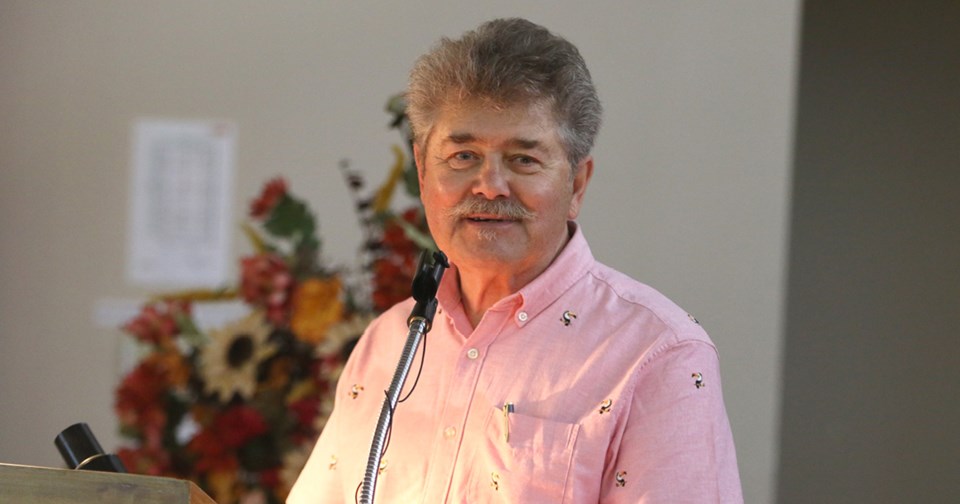
Steven Ross Smith, the founding executive director of Sage Hill Writing, gave
the Kroetsch keynote speaker. He described the history of the non-profit
organization as part of its 30th anniversary. Photo by Devan C. Tasa
Steven Ross Smith, who’s written around a dozen books over the course of four decades, was the founding executive director. He was in that position for 18 years.
“It’s pretty amazing, actually, to think something that started as an idea and then was developed into a program would survive this long,” he said.
Smith was the Kroetsch keynote speaker at an event open to the public on July 6. During his speech, he talked about the history and development of Sage Hill Writing, his own path as a writer, the challenges of writing, and about Robert Kroetsch, who was a critic, novelist, poet and writer.
“He was a mentor to many writers and he taught at Sage Hill on more than one occasion, at least four occasions.”
About 1,000 writers have gone through the program in 30 years, said Tara Dawn Solheim, the current executive director. About 700 have published.
There were 32 writers at the retreat, coming as far as BC and New Brunswick.
Sandra Ridley, who lives in Ottawa but was originally from the Foam Lake area, taught the poetry class. She’s taught for two years and was a participant in the past.
“I am here with six amazing poets in this really incredibly charged environment, being nourished by them and trying to give them something back,” she said. “They’re working on their manuscripts and I’m here is their mentor, editor, companion, champion.”
She said the course has been intense, with full days of writing and having to shift between different pieces, all of which have their own tones and emotions.
“It’s this shift being able to move between people projects, which is a challenge, but also a real source of joy in a way and keeps me on my toes.”
Tanis MacDonald taught the non-fiction course. She participated in the course herself in 1995 and has taught for two years.
“What’s very important to remember is that Saskatchewan has a really awesome support for writers from the Saskatchewan Writers Guild and through the Sage Hill Writing experience and not every province has that,” she said. “People here should take advantage while you can because such things are often under peril under particular kinds of governments who don’t think the arts are important.”
Ridley also encouraged people to take part in the future.
“It’s such a fantastic experience for any writer at any stage, and very nurturing environment, so I think they should all come on.”
Advice for aspiring authors
The teachers and special guests at the Sage Hill Writing Experience had some advice to give aspiring authors:
“Get your bum on the chair and get writing. That’s the only way to do anything. You can dream about ideas and think about ideas, but until you sit down and start putting words on paper and sticking with it, Ideas are just ideas. Writing is writing. It’s a verb, it means you have to do it.”
—Steven Ross Smith
“Writers have to have stamina, they have to be able to go long periods without getting feedback on their work… You have to believe in your work and more than anything else, you just have to write it. Don’t worry about figuring it out. Figure it out later. Just write it now.”
—Tanis MacDonald
“I’d ask them to really consider what they want their readers to feel, because readers want to feel something, but once they decided what that emotion is, then to construct their poem or their writing in a way that builds that. It’s not so much about the message, but how the message is delivered.”
—Sandra Ridley
SaskToday
Learning the sound of language
Learning the sound of language
Christopher Lee – May 25, 2018
Writers from across the country descended upon St. Peter’s College for Sage Hill Writing’s Spring Colloquium, and to mark the occasion, writers were invited to the Reid-Thompson Public Library for a poetry reading on May 15.
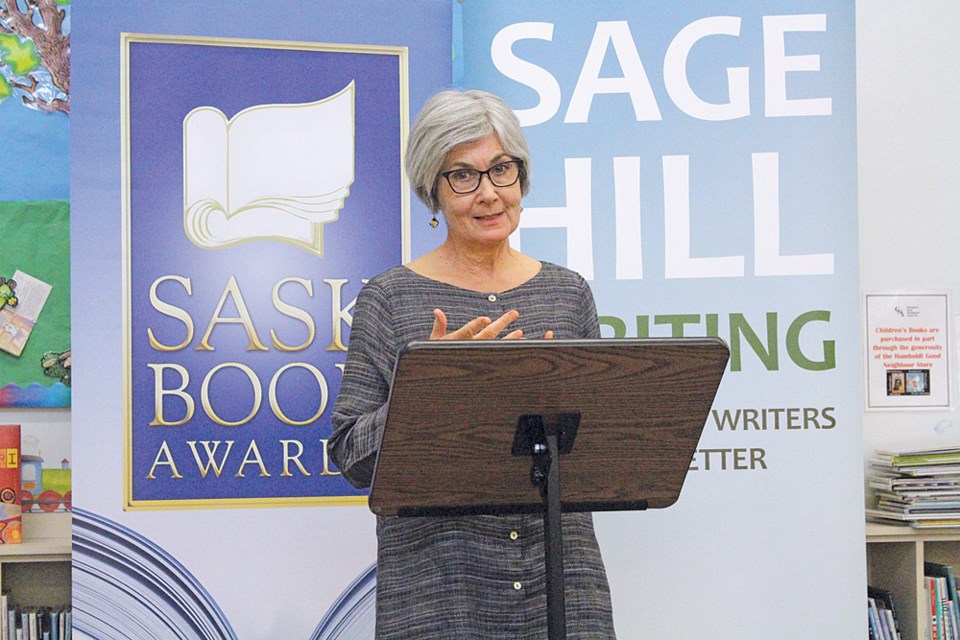
Writers from across the country descended upon St. Peter’s College for Sage Hill Writing’s Spring Colloquium, and to mark the occasion, writers were invited to the Reid-Thompson Public Library for a poetry reading on May 15.
Colloquium instructor Sylvia Legris, and writer Katherine Lawrence both brought their literary works to the Reid-Thompson library, reading both published and in-progress works.
Legris is a Winnipeg-born, Saskatoon-based writer, whose poetry has appeared in a number of literary magazines including the New Yorker, Conjunctions, and Granta.
Legris’ third collection of poetry “Nerve Squall” also won the 2006 Griffin Poetry Prize, described as “Canada’s most generous poetry award.
Katherine Lawrence reads from her collection Stay, during a reading at the
Reid-Thompson Public Library on May 15. Photo by Christopher Lee.
Lawrence is a Hamilton-born, Saskatoon-based writer, whose works of poetry have appeared in literary journals across Canada and the United Kingdom.
Lawrence’s work has also resulted many awards. Her first collection of Poetry “Ring Finger, Left Hand” won the Saskatchewan Book Awards’ Brenda Macdonald Riches Award for best first book.
Her second work “Lying to Our Mothers” was shortlisted for a pair of awards including the Anne Szumigalski Award and the Alfred G. Bailey Prize for poetry.
Another of Lawrence’s works won the 2014 City of Regina Writing Award, while her young adult novel in-verse Stay earned her a 2018 Saskatchewan Book Award nomination for Children’s Literature.
Having readers come into the library and showcase their work is great, says librarian Michael Langhorst because it gives the readers a chance to gain exposure and read in front of a bit of a larger crowd.
While the readers were gaining exposure, Sage Hill Writing Executive Director Tara Dawn Solheim says she hopes those who came to take in the readings were able to gain a new appreciation for the sound of language.
“You get to take in each syllable, the sound of it and when you go back into the world you might listen differently or you might listen to the birds differently or you might listen to the radio differently.”
Bringing the reading to the library was something new for this year, with Sage Hill Writing Executive Director Tara Dawn Solheim noting with the colloquium returning to St. Peter’s College for the first time in a number of years, having the reading at the library seemed like a good fit.
“I like this area and I think working with the library was really fantastic. They were super supportive.”
With the library always looking to bring more readings into the library, librarian Michael Langhorst says it was great being able to partner with Sage Hill Writing.
“It’s a good partnership. If we can partner with them once a year then why not? We’ll see what happens in the future.”
The partnership and the move to the library seemed to be an effective one, with a relatively large crowd in attendance, including some who made the drive from Saskatoon.
Langhorst was really happy, noting it is a great way to provide exposure for both the city and the library.
“It’s exciting when people are interested and seem very engaged as well. Everyone was laughing and actively participating and that’s what really matters,” added Solheim.
Solheim would like to thank everyone for their support in making the reading a possibility.
The Saskatoon StarPhoenix
Sage Hill offers free writing workshops for teens 14-18

Sage Hill offers free writing workshops for teens 14-18
By Saskatoon StarPhoenix – June 7, 2017
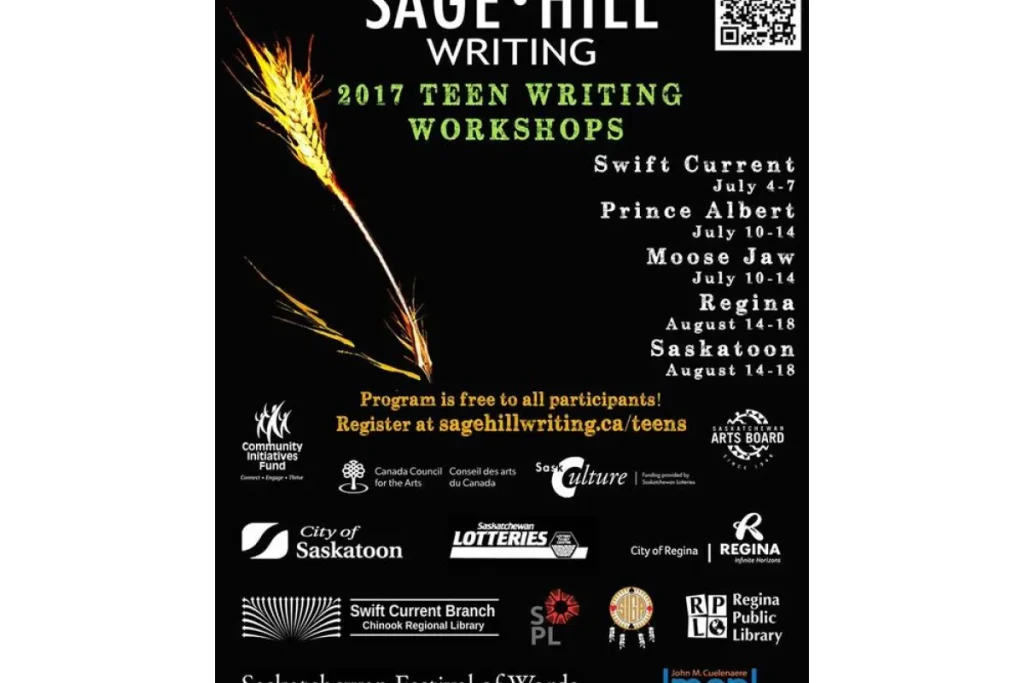
Sage Hill Writing, a not-for-profit organization that offers creative writing development programs, is offering free writing workshops to give creative teens ages 14 to 18 the opportunity to develop their creative writing skills with a professional writer. The five-day programs are available in Moose Jaw, Swift Current, Prince Albert, Saskatoon and Regina.
Teens can apply online at https://sagehillwriting.ca/youth-workshops/ or by calling 306-537-7243.
The workshops are designed to encourage the growth and development of young writers who want to connect with the writing community and learn about writing as a craft and a profession. Under the mentorship of local, published authors, the teens are guided through writing activities in various genres. Instructors speak on the writing life, professional expectations, and publication.
This year, instructors include notable authors Lynda Monahan in Prince Albert, Katherine Lawrence in Moose Jaw, Peggy Worrell in Swift Current, Sara-Jane Keith in Saskatoon and Coby Stephenson in Regina.
Each workshop features a guest appearance by a second author from the community.
Sage Hill says that participants gain important transferable skills: the abilities to write clearly and persuasively, consider various perspectives, give and receive constructive criticism, analyze information, and speak publicly.
Also, by bringing youth from various backgrounds together to focus on a subject of common interest, the workshops help bridge cultural barriers, connecting teens with one another in an atmosphere that encourages them to grow and to contribute to the cultural vibrancy and health of their communities.
Meanwhile, potential donors and sponsors are encouraged to contact Sage Hill at or 306-537-7243.
Here are the dates:
Swift Current, July 4 — 7, 10 a.m. — 5:30 p.m.
Prince Albert, July 10 — 14, 10 a.m. — 4 p.m.
Moose Jaw, July 10 — 14, 10 a.m. — 5 p.m.
Saskatoon, Aug. 14 — 18, 10 a.m. — 4 p.m.
Regina, Aug. 14 — 18, 2017 10 a.m. — 5:30 p.m.
CBC
The Book of Negroes author Lawrence Hill works with new writers at Saskatchewan retreat

The Book of Negroes author Lawrence Hill works with new writers at Saskatchewan retreat
Five emerging authors hang out with Lawrence Hill for 10 days
Posted: Jul 31, 2014
Lawrence Hill, author of The Book of Negroes, is in Saskatchewan for a writers retreat.
“It’s a great atmosphere, very supportive,” Hill told CBC in an recent interview. “Writers need to help each other so I’m happy to do that.”
Hill is spending time with five emerging authors at the Sage Hill Writing Experience at St. Micheal’s Retreat in Lumsden, Sask., 30 kilometres northwest of Regina.
“It’s a great way to be connected to the community,” Hill added. “The wonderful thing about coming to Lumsden and dealing with writers through Sage Hill Writing is that you are exposed to developing writers from all over Western Canada. It’s a great way to sort of get more familiar with what’s happening in literature in Saskatchewan and points further west.”
Hill said he is also happy to share his experience with the up and coming authors. The participants are at different stages of development. Some have published books while others are brand new to writing and writing creatively for the first time.
“I can talk about structure, the effectiveness of dialogue, the appropriate use of narrative technique, point of view, plot manipulation,” Hill said. “All those things are things I can step in and hopefully be a helpful mentor.”
Hill also spent some time in the province in the 70s and later wrote about working on the railway at Gull Lake, Sask., in the short story, Meet You at the Door, published in The Walrus.
Media Mentions
CBC
UNMET by stephanie roberts
UNMET by stephanie roberts
A poetry collection on frustration, identity, justice and hope
CBC Books · Posted: Apr 08, 2025
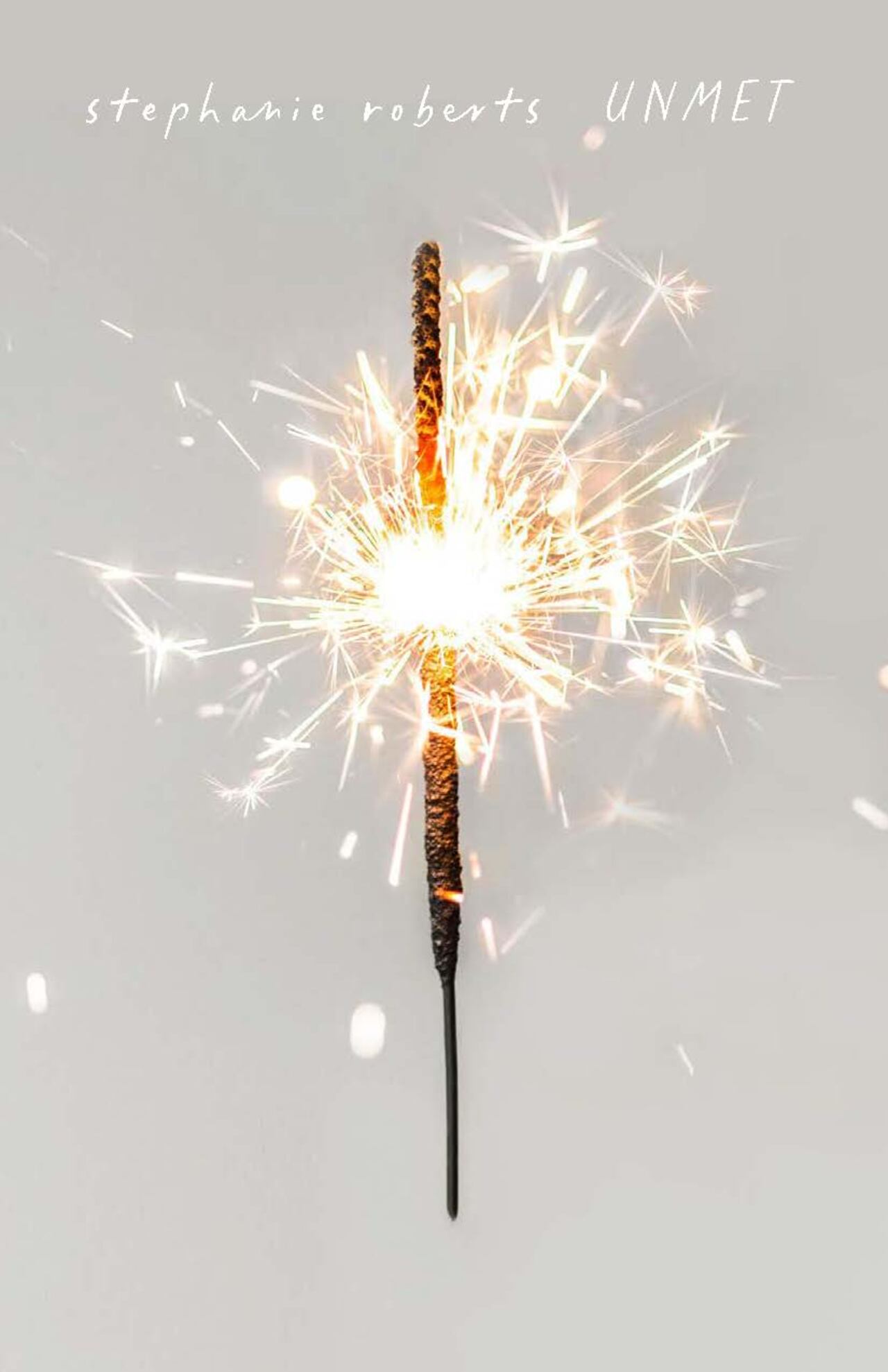
Leaning deliberately on the imagined while scrutinizing reality and hoping for the as-yet-unseen, UNMET is a poetry collection that explores themes of frustration, justice, and thwarted rescue from a perspective that is Black-Latinx, Canadian, immigrant, and female.
Drawing on a wide range of poetics, from Wallace Stevens to Tony Hoagland and Diane Seuss, roberts’s musically-driven narrative surrealism confronts such timely issues as police brutality, respectability politics, intimate partner, and ecological crisis, and considers the might-have-been alongside the what could be, negotiating the past without losing hope for the future. (From Biblioasis)
stephanie roberts was born in Panama, raised in Brooklyn and has lived most of her adult life in Quebec. Her poetry collection, rushes from the river disappointment, was a finalist for the 2020 Quebec Writers’ Federation’s literary award’s A.M. Klein Prize for Poetry. She received the Sage Hill Writing award for Black Excellence and is a grantee of the Canada Council of the Arts. Her work is featured throughout Canada, the U.S. and Europe.
The Giller Prize
Giller Prize Spotlight: Jane Urquhart

Giller Prize Spotlight: Jane Urquhart
Published on September 24th, 2024
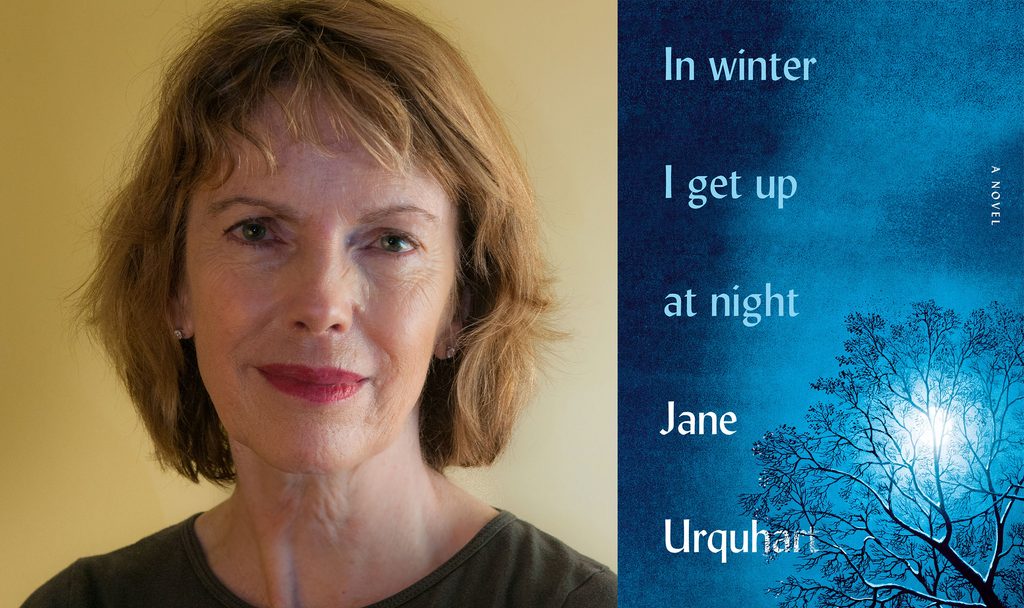
Jane Urquhart’s novel, In Winter I Get up at Night, has been longlisted for the 2024 Giller Prize.
Jane Urquhart, one of Canada’s best loved writers, was born in the north (in Little Longlac, Ontario), and grew up in Northumberland County and Toronto. She is the author of eight internationally acclaimed novels, which have received Le prix du meilleur livre étranger (Best Foreign Book Award) in France; the Trillium Award; and the Governor General’s Award, and have been finalists or longlisted for the International IMPAC Dublin Literary Award; the Rogers Communications Writers’ Trust Fiction Prize; the Orange Prize; The Giller Prize; the Booker Prize; and the Commonwealth Writers’ Prize for Best Book, among others.
What inspired you to write In Winter I Get up at Night?
Two prairie related life events:
When I was a child, my Ontario, rural Irish-Canadian family often spoke of the one brother (great-great-uncle to me) who had gathered up his family in the 1920s and had gone west. According to this story, he had no sooner built his house and barn when both were destroyed by a tornado.
There were other details in the story. In one version an old lady had been carried by wind three fields to the west. In another, it was was a horse and buggy that was dispatched in this way. In both versions, miraculously, no one, and nothing — beyond house and barn — was injured. Much later I discovered that one boy had in fact been very seriously injured.
In this way, I learned about versions and points of view, and how stories enable people to mythologize their ancestors.
As a younger writer I spent two or three summers teaching in Saskatchewan at “The Sage Hill Writing Experience” with people like Patrick Lane, Louise Halfe, and Merna Summers, and each summer the “Experience” set itself up in a different location. Taking its cue from the Summer School for the Arts, which took place in an abandoned TB Sanitorium in the Qu’Appelle Valley, Sage Hill moved into an abandoned DEW-line era radar military base, and ultimately, via St Michael’s Retreat, into St Peters, a fully functioning Benedictine Monastery. The experience was essentially blown around in Saskatchewan in the same way the people and things my elder relatives spoke about were blown around. There was a different version every year.
I always knew I would someday have to write a novel about this magical, shape-shifting aspect of the Northern Great Plains. These were the seeds of the narrative.
Everything else was a product of my imagination.
What do you hope readers take away from In Winter I Get up at Night?
The fact that there has always been divisiveness in human society. But at the same time there has always been beauty and hope.
Where is your favourite place to write and what is your process?
My favourite place to work has always been my kitchen table. Sometimes, if I am working very hard, and unless I am sleeping, I basically live at the kitchen table.
At one time I had a wheeled office chair that I could navigate to the fridge, the pots and pans, the stove, and back again to my place at the kitchen table.
I let the book determine my process. It builds for a long period of time in the back of my mind with me paying some attention now and then while driving, walking, or before and after sleep.
Then comes the time when it insists on being born.
Is there an activity you do to help inspire writing?
I read around the subjects that intrigue me. Some people might call this research. But it is less organized than research. I browse, or graze around phenomena that have held my attention. A great deal of this relates to place. Observation in the real world has a lot to do with my writing. I use the internet, but not that often. Non-fiction books are important to me. If I can’t find them in a library, I order from Abe Books.
What’s a book you recommend others read and why?
I read a lot of poetry and have done so since I was an adolescent. I have just finished reading a very strong first book of poems called “Master” by Simon Shieh. It is an intense study of power and powerlessness, desire, love, and aversion. I am also reading “The Principle of Rapid Peering” the most recent book by Sylvia Legris, a poet who is connected in a vital way with nature and the surface of the earth. A call for the act of observation, it is devotional in its intensity.
I would recommend both these recent books and many other works of poetry.
Global News
La Ronge, Sask., teen becomes first Youth Writing Experience participant with sight loss

La Ronge, Sask., teen becomes first Youth Writing Experience participant with sight loss
By Chinenye Anokwuru – August 10, 2020
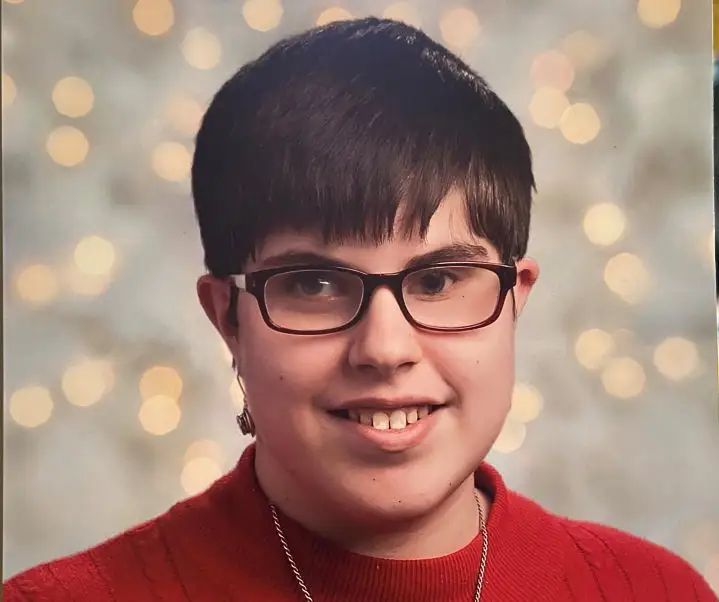
A teen from La Ronge, Sask., has become the first youth with sight loss to participate in the Sage Hill – Teen Writing Experience program.
The program, which is held each summer throughout the province, offers youth the opportunity to develop their creative writing skills with a professional writer as an instructor.
Sixteen-year-old Karis Oscienny joined five youths across the province to take part in the writing course led by spoken-word poet Janelle Pewapsconias, from July 20-24 via Zoom.
For her piece, Oscienny wrote and edited a short story titled “Decomposed”,
about challenging stereotypes through the eyes of a character struggling to fit in.
Jackie Lay/CNIB
“At the time I didn’t know that I was the first blind person to join the program so that was a cool thing,” Oscienny said.
“It was a good experience to gain, we did writing prompts throughout the week, we talked about diversity and stereotyping and how to end it.”
For her piece, Oscienny wrote and edited a short story titled “Decomposed”, about challenging stereotypes through the eyes of a character struggling to fit in.
She said the experience provided an opportunity to grow as a writer, connect to other youths and gain a new experience.
“The parts about editing were my favorite since editing has been on my mind a lot and we talked about story structure, which will help me in plotting out my story going forward because that’s always been a struggle for me,” the aspiring writer said.
“Having writing experiences like this accessible provides new opportunities for youth who are blind or partially sighted to participate more fully in life, which in turn gives them an advantage in their future,” said Ashley Nemeth, the program lead for community engagement and advocacy with Canadian National Institute for the Blind.
Oscienny started writing at a very young age and has since developed a passion for storytelling with her first book already in the works.
“I wrote my first story when I was nine and then from there I kept thinking I want to write a book, but I had so many ideas that wouldn’t go anywhere and then eventually a couple of years ago I finally had this idea that I wanted to make into a book,” she said.
“I joined a little writing group in my town that sort of helped me hold myself accountable for my writing and I ended up completing the first draft of that finally last year.”
Sage Hill workshops are held in partnership with local libraries and are offered free of charge to participants.
SaskArts
Mentorship Inspires Emerging Writer

Mentorship Inspires Emerging Writer
December 13, 2018
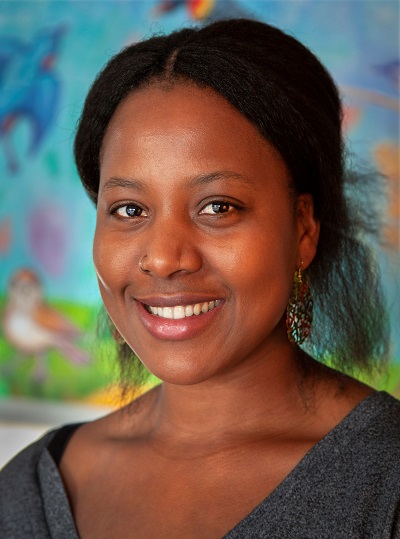
Iryn Tushabe received an Independent Artists grant to work toward the first draft of her novel and attend a retreat at Sage Hill Writing Experience.
Iryn Tushabe says the decision to write full-time was thrust upon her in 2015. The Uganda-born journalist’s work permit had expired, and she had to leave her job while she waited on the results of her permanent residency application. “Suddenly, I had time on my hands, time that I spent worrying about money, my status and my family,” she says. “All through that spring and summer, I thought a lot about the idea of ‘home,’ how it applied to me, an immigrant writer without status, but also what it meant to different people at different times.”
Iryn Tushabe. Photo by Robin Schlaht.
So, she began writing and exploring that idea – in non-fiction articles and personal essays at first, then in short stories and a semi-autobiographical novel, Everything Is Fine Here. She enjoyed it so much that, even once it was legal for her to work again, she chose to continue writing fiction instead of returning to journalism.
Tushabe has received numerous accolades for her work. She was a runner-up for the City of Regina’s Writing Award in 2017 and 2018, longlisted for the 2016 CBC Creative Nonfiction Prize and received second place in a Readers Digest competition in 2015. This year, her short story, “A Separation”, has been included in The Journey Prize Stories anthology.
An Independent Artists grant enabled her to work toward the first draft of her novel and attend a ten-day retreat at Sage Hill Writing Experience with Toronto writer Alissa York. Before arriving at the workshop, Tushabe was close to abandoning the novel. But York helped her work through elements of her draft that were problematic, such as timelines, scene writing and point of view. “I overcame all of the challenges that were holding me back,” Tushabe says. “I feel like I know how to solve those problems now, so I don’t get discouraged.”
She continues to be mentored by York, this time through a creative writing course at Humber College. “I feel like I’ve gotten better though working with her. I’m happy where the novel is now and what the story has become compared to the first draft,” she says. Everything Is Fine Here has already received interest from publishers, and Tushabe is seeking an agent.
In 2017, she also participated in the Saskatchewan Writers’ Guild’s Mentorship Program, which pairs an established writer with an emerging one. “I am constantly overwhelmed by how much support there is for emerging writers in Saskatchewan. I don’t think I could be at this stage with this novel if there wasn’t the support that I’ve been able to tap into,” Tushabe says.
The Walrus
Digital Distraction Is Bad for Creativity

Digital Distraction Is Bad for Creativity
What a silent evening with an author I admired taught me about solitude and writing well
by Steven Heighton
Illustration by Joan M. Mas
Updated 11:39, Jul. 21, 2022 | Published 12:12, Nov. 30, 2017
In July 2010, I travelled to Fernie, British Columbia, for a ten-day stint as a fiction instructor at a summer writing school. On the final evening, the organizers, facilitators, and participants gathered at a golf course clubhouse on the edge of town for a closing banquet. I was looking forward to this event for a lot of reasons, one of them being the prospect of socializing in a fully relaxed way now that the hard work was over for all of us, but also because the banquet would be my first ever chance to meet the eminent fiction writer, poet, and mentor Robert Kroetsch, who was to be the guest of honour.
In that spacious, high-ceilinged Fernie clubhouse we were assembled by 5 p.m. and standing around with drinks and appetizers. Sunlight spilled in through a towering picture window that looked out on Celtically green fairways and toward a sawback skyline of peaks walling in the valley a few miles to the west. I roamed around a bit, looking for Kroetsch. I asked one of the organizers if maybe he’d had to cancel and wouldn’t be here after all. “No, actually, he’s having a breather outside,” she said. “Want to go out and meet him?”
She led me out and across a wide concrete patio. Kroetsch was sitting alone on the far side, at a round table with an undeployed umbrella. He was turned away, facing a late afternoon sun that was still some distance above the serrated ridgeline. I think he might have been dozing lightly. The organizer cleared her throat and introduced me. Kroetsch gripped the cane resting beside his chair and made to get up, but both the organizer and I said, “No—please.” Kroetsch invited me to sit down beside him in the other white plastic chair. The organizer asked if he needed a refill—I think he was drinking ginger ale—but he said he was fine. He looked at my tall glass of cold beer and said, “That looks good, but I can’t drink it anymore.”
The organizer left us and for a few minutes we talked. I told him about first encountering his novels in my early twenties and how one of them, Badlands, had helped inspire a novel of my own; he told me, with a generosity and courtliness for which he remains renowned among younger writers, that he’d read and liked a couple of my books, including the one I’d just mentioned. It seemed clear that he had read them. Had he actually liked them? Who can say? It doesn’t matter. He spoke quietly, obviously tired, and not having much vocal strength, either, so I made no effort to push or pursue the conversation and in fact wondered if I should just leave him in peace. But the organizer was not bringing others out to meet him, and he seemed happy enough to have company, so I just sipped my beer and sat beside him, a couple of feet away, and we watched the sun slipping toward the increasingly well-defined silhouette of the ridge. For a while, the only sounds were of sprinklers hissing on the fairways and the occasional crack of a driven ball. Now and then, the glass door to the clubhouse would open as somebody entered or left, and a little fanfare of crowd chatter would escape. It was gradually getting louder, of course.
Silence in the presence of a stranger usually makes me uneasy. No—in fact, I find it all but unbearable. The impulse to disarm others through speech—as if they’re ticking time bombs—makes me open my mouth even when it’s obvious I shouldn’t. Once, at a silent meditation retreat, I had to leap up and flee the dining hall because the sober, ruminative, communal chewing of my fellow retreatants was about to convulse me in a panicked laughter. Whenever I meet an older writer I admire, I tend to talk too much, to hurriedly represent myself, bullet point by bullet point, as if at a job interview or on a speed date, probably hoping to pre-empt the negative opinion this person would otherwise surely form. A common enough feeling among writers, I suspect, since so many of us were pariahs, nerds, wallflowers, social refugees in our formative years.
But on the clubhouse patio beside Robert Kroetsch, the lengthening silence was not making me uneasy at all. Maybe I felt relaxed because he seemed less like a stranger to me than most elder writers would, since I’d read several of his books at an impressionable stage? Hardly. By any definition, we were strangers. Still, for some reason, it felt clear to me that he, too, was savouring the silence, content to have company on this exceptional summer afternoon but even more pleased to sit quietly. At least twenty minutes went by and not one syllable said. The sun was now appreciably lower. The golf course’s colours—innumerable stained glass variations on green—were changing and deepening, the hollows, sand traps, and water hazards pooling with shadow.
Again the door behind us opened and released a gust of sound from the clubhouse, and it struck me—or it strikes me now as I try to conjugate the moment—that that crowded hall is an apt analogy for the public side of the writer’s life, in both its positive and negative aspects. As writers, we sometimes crave company, inclusion—the respect and affection of colleagues, the interest of readers, not to mention the social input and “material” that our fellow human primates supply. But we also need solitude and silence, or something close to it. It’s in seclusion and quiet that we do the actual work.
All artists, always, have needed to situate themselves somewhere on the axis running between inclusion and seclusion, social noise and silence. Or to lend that latter pole a more extreme label: self-exile or -banishment. And certainly, at times, it can feel like a kind of exile, when the writing seems especially difficult and humiliating and you’d rather enjoy the easy fellowship of a meal and drink with a friend.
A literary colloquium, like that one in Fernie, is meant to offer its participants those two necessary poles in one neat package. On the one hand, workshops, public readings, communal meals, one-on-one conversations, restorative sprees of late-night dissipation; on the other, creative solitude and silence, a room of one’s own.
But back to that clubhouse. What exactly is going on there? The same stuff that’s been going on in clubhouses of all kinds for as long as colleagues have been gathering. It’s a place where—as human primates first and writers second—we all reflexively seek the comforts of company, the pleasure of mutual respect, sometimes the professional necessities of connection and alliance. At times, of course, our social needs there are more urgent. We’re hoping for a few hours of oblivion, self-forgetting, a remission from grief; we’re trying to keep fear from keeping us from life; trying to keep weariness and lost faith from dimming us to shadows or erasing us completely. And we’re contending for the eyes and ears of colleagues and strangers. Or colleagues who remain strangers. Or who now seem like strangers. We know what it is to feel spectral and separate while around us others, all toasting and laughing, appear so solid, valid, fixed and assured within their skins, securely woven into the world—though perhaps at the same time we sense that they too may be busily outsourcing their self-esteem to strangers, yes, and in a manner much easier to recognize and advise against than it is to transcend.
Something awful can happen to anybody involved in any field, club, league, profession, guild, or milieu—whether the competitive triathlon circuit, the guild of Canadian potters, the Call of Duty or Clash of Clans video-game networks, the fly-fishers club of Alberta, dog breeding and showing associations, the professional rodeo circuit, bird-watching federations, the readers of Dentistry Today, competitive Scrabble, the Canadian literary world—you name it. The thing is this: before long, you stop noticing the walls around you and the ceiling or artificial dome above, and you start to regard your particular clubhouse and microcosm as the whole world. The club’s inner strife and spats, affairs and enmities, triumphs and disgraces, come to seem far realer and more consequential than they are. You’re inside the matrix and now it’s all you know. The network of your connections is a web and you’re enmeshed. A setback in that enveloping little pseudocosm can feel crushing.
Yet from outside the clubhouse walls, it’s easy to see how minor such reverses really are. For instance: receiving a third straight rejection for a short story that you feel certain is one of your best. If that happens on the wrong day, in alignment with a couple of other, smaller setbacks—let’s call this effect a malignment—it can produce an emotional minor chord and tip you over into the blues, or worse. And yet when you read online about a suicidal depression triggered, apparently, by defeat and demotion in the Clash of Clans hierarchy, you’re struck by how parochial that sounds. It’s just an interactive video game. For the most part, the players have never met each other and don’t know each other’s real names. Am I really comparing that milieu to the book world? Why not? After all, hundreds of thousands of people—far more than in our little bibliocosm—claim citizenship there. To them, our world would seem awfully small and peripheral.
Still, and despite modest numbers, the din in the literary clubhouse can get pretty loud. And I want to reflect for a moment on the nature of the actual noise in an actual clubhouse. Next time you’re at a large gathering in a space of that kind, try stepping away, closing your eyes, and listening to the sound of a few hundred voices in overlapping colloquy. Let your ears go out of focus, so to speak, in the same way you can do with your eyes. What you’re now hearing is pure undifferentiated palaver, a throbbing drone in which hardly a word can be made out—a sort of linguistic chowder. While the cause is simple acoustical physics, the effect is richly ironic: the sum total of hundreds of attempts to convey meaning, to build semantic bridges, is instead a meaningless wall of sound—the same meaningless wall you encounter in a thousand different clubs, a thousand clubhouses, on any given day.
How easy to forget that you can simply head out the door, close it behind you, and walk away, the sound fading to nothing. And to think that this silence was always out here, waiting for you! That you could find it and be nourished by it whenever you chose!
Except nowadays you can’t, or not so easily. Because the clubhouse—with its steadily mounting, deafening clamour—has gone virtual, digital. First email and the internet and now social media, in a more incursive, comprehensive way, have made it difficult to find the door and slip outside. Or to rephrase the problem, you’re no longer forced to leave the clubhouse, like in the old days, at closing time, the house lights coming on, waiters aggressively clearing away the remains of the canapés and giving stragglers the hairy eyeball. Hemingway once sneered at those writers who could “talk away any number of books” while lounging in cafés conversing with colleagues. But those chatty flanêurs had to go home at some point, and when they did, there were fewer places to hide from the work, or at least from their own minds. Now, Facebook and the Twitterverse constitute virtual cafés where you can listen 24/7 to the sound of your own externalized voice—your ego, in other words—which is not the voice that murmurs itself onto the page or the screen when you’re creating.
And now that you can choose to remain online all the time, why wouldn’t you? Who wouldn’t prefer to be diverted, to skim laterally link to link, than to pursue the interminable, doubt-filled, vertical work of mining the imagination and locating the right words? Guilty as charged. And surely it’s easier and more gratifying to participate in communal iregasms, so to speak, when your countless friends on social media are savaging the latest fallen celeb. At any rate, let’s call all of this digital data what it is: gossip. Even international news is essentially gossip writ large (it always was). And if diplomat/memoirist Charles Ritchie had a point when he remarked that the two most enjoyable things in the world are sexual intercourse and gossip, it makes sense that our collective love of gossip—in the broadest sense of the word—tempts us to stay constantly in the sunny clubhouse, drink in hand. Nothing has ever pandered and pimped to our primate natures more effectively than the internet. And I make myself exhibit one here. I’m a more distracted writer than I was a decade ago. Which means I’m not writing as well as I might be, period.
And if I know that for a fact, why is it still so hard to walk away?
Writers and artists, most of them introverts, have traditionally been able to find the solitude in which to work because as introverts they craved and welcomed solitude; they could only endure a certain amount of time in company. Now, social media and the internet offer the introvert a poisonous compromise: you can be alone in your room and at the same time connected to others, if more or less on your own terms. Alone, yet not alone.
But for an artist, this paradox is problematic because there can be no compromises in creative solitude. Don’t get me wrong—I’m not saying that you can only write well when no one else is in the house, as has been true, reportedly, for Alice Munro. I’m saying that the particular nature of digital distraction is creatively injurious. I used to find the sounds of my then-small daughter and her friends playing in the house while I was writing—and occasionally barging in to show me something or ask for something—to be, on balance, creatively helpful. I felt less lonely and at the same time more focused on getting the work done, published, and paid for; that unsilent presence was a reminder of one key reason I was doing the work and whom I was doing it for. But the knowledge that emails are steadily pinging into my inbox nudges me out of the task—out of the dreamtime of deep creativity—in a different and damaging way.
The organizer brought two more fans out to meet Robert Kroetsch. I figured it had to happen. The sun by now was just a few fingers above the ridgeline. I’d been willing it to stay and to slip no lower—as if to suspend the moment, along with the sun, in exactly the way that time never permits. I said goodbye and returned, happily enough after all, to the clubhouse for another beer, dinner, and dozens of conversations, some engrossing, some gratifying, some confusing or simply dull. The usual social range.
I realize that Robert Kroetsch kept his silence partly out of fatigue, but I also choose to believe that he’d reached an enviable stage where he felt less of a need to talk, and to write: to explain himself to the world and the world to himself. He was in his eighties, had published some thirty books, had done his life’s work—an honourable life’s work by any standard. How enviable, finally, to surmount the need to represent yourself to others, to wonder if they secretly feel you don’t measure up or don’t deserve whatever you have. The same things we all wonder. Maybe he, too, still wondered those things. How can I know?
I do know he deserved to feel that his work was done, that he’d said what he had to say.
When he died the following summer, I felt both saddened by the news and lucky to have shared that half hour with him. Later that same year, 2011, I published a collection of memos and essays on creativity, and in one memo I said—not about Robert Kroetsch, but certainly thanks to him—“Truly integrated, enlightened souls may dispense wise advice, but they seldom write interesting fiction or poetry. They don’t need to. The natural medium of the achieved spirit is silence.” To which I added this codicil: “The rest of us talk and write to find our way, and it’s from the rest of us—with divided, conflicted selves—that good poetry and fiction might emerge.”
More and more now, I fantasize about arriving at a place and a time when I can finally prefer silence. Of course, dreams of arrival are never more than figments. Resign yourself to the road, I keep coaching myself, there’s no arriving. To be sure, for those of us who haven’t yet accomplished our life’s work—nearly all of us—public language, the medium of the clubhouse, remains what we have. And so we go on trying to make sense of our many solitudes, and this layered mess of a world, by deploying words as well as we can.
I think I should choose to see Robert Kroetsch’s silent fellowship—one of my best memories of the last decade—not as the promise of some eventual reward of serenity and wisdom but as a piece of advice mimed to a younger writer. Walk away and find enough of the necessary silence now. The sun is lower in the sky than it looks.
Adapted from the Robert Kroetsch Keynote Address delivered by Heighton at the Sage Hill Writing Experience in Lumsden, Saskatchewan, in July 2017.
Write Where You Are – Miji Campbell
From the Sage to the Page

From the Sage to the Page
By Miji Campbell – 2017
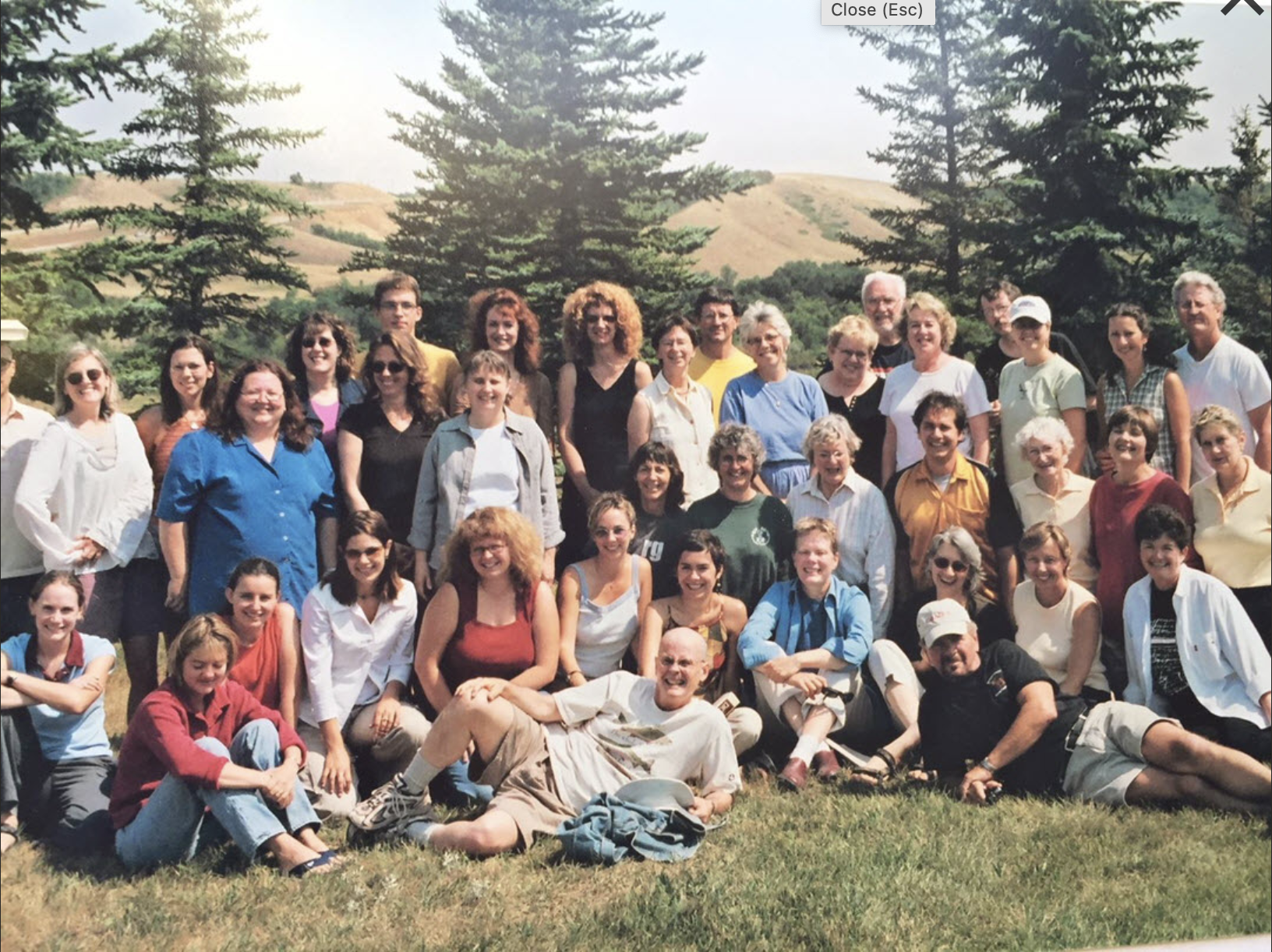
One thing that I’ve realized after all the writing workshops, retreats, conferences and courses I’ve been to across Canada is how supportive this writing community can be. I’ve dug up this photo from the 2003 Sage Hill Writing Experience in Lumsden, Saskatchewan, by way of introducing Steven Ross Smith, who was executive director at Sage Hill from 1990-2008. (He’s wearing the ball cap, reclining in the front row of the photo. Some other people you may recognize as well!) That’s where Steven and I first met, reconnecting in 2009 when he was literary arts director at the Banff Centre. He’s been a booster, mentor, and guide all along the way. Thanks for the wisdom and advice, Steven, and for writing this article about my book journey than began at Sage Hill.
Find the article here: Miji Cambell: Pushing through Anxiety by Steven Ross Smith
Steven Ross Smith is a poet, fiction writer and arts journalist. His latest poetry book is Emanations: Fluttertongue 6. He lives and writes in Banff and Galiano Island. Find him at fluttertongue.ca; stevenrosssmith.com and on Twitter @SonnyBoySmith
The Leader-Post
Cassidy McFadzean plays with language in her Sask. Book Awards-nominated first book

Cassidy McFadzean plays with language in her Sask. Book Awards-nominated first book
By Ashley Martin, Regina Leader-Post
April 29, 2016. Last Updated: June 2, 2020.
Cassidy McFadzean will have a memorable 27th birthday on Saturday: She’s a nominee for the 2016 Saskatchewan Book Awards.
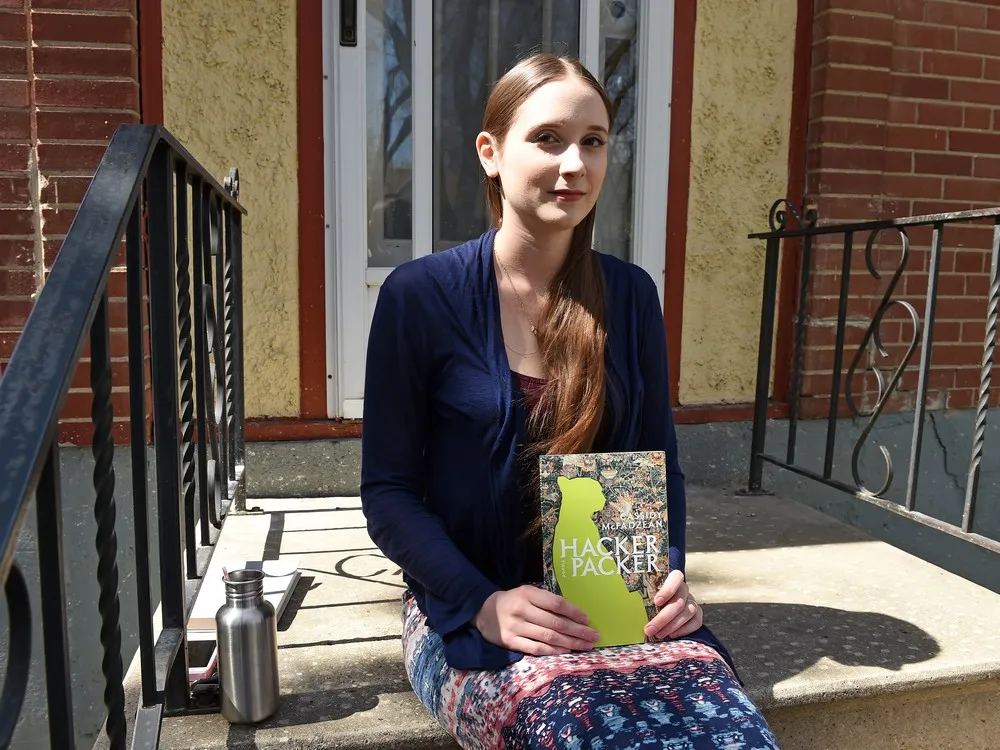
McFadzean’s first book — a collection of poetry entitled Hacker Packer — is up for the First Book Award and the City of Regina Book Award.
McFadzean has been writing all her life, but discovered poetry eight years ago at the Sage Hill Writing Experience. A master’s in creative writing from the University of Regina furthered her interest.
Q: Why do you focus on poetry versus other styles of writing?
A: It really allows you to just explore language and words themselves, as well as the musicality of language. I’m kind of a nerd in a couple of ways, so I really love looking at where words come from, Old English forms and these type of things in my poetry.
Q: How did this book come about?
A: It kind of came together on its own. The book is very much a collection of individual poems, so there’s no kind of overarching theme or idea.
I was fortunate after my MA to be able to travel, so I went to Europe and I travelled in Greece and Rome. That’s where the poetry really grabbed me. … A lot of the poems in the collection are about the disjunction between the ancient world and the contemporary world of iPhones and Instagram.
I think a lot of my poetry comes out of a desire to express the strangeness of just being alive and being in this world, because when you really think about it, it’s pretty strange at times.
Q: Where does the title come from?
A: I used to have this terrifying dream about this imaginary friend (my brothers) had and they would kind of taunt me with “that’s Hacker Packer.” But I also think in regards to my poems as kind of hacking and packing together different aspects of language and lines in some way. It’s a strange title.
Cassidy McFadzean is a poet whose first book, Hacker Packer, is nominated
for two Saskatchewan Book Awards. Don Healy /Regina Leader-Post
Q: Do you write about Saskatchewan?
A: (One) thread running through the collection is poems about growing up in North Central Regina. I live here still and I grew up here, so a lot of the poems are talking about childhood experiences in this community and just what a profound community it is. … Some of these poems go into the political realm as well.
I go by the phrase “the personal is political,” so when you write about your own experiences — whether it’s as a woman or as a settler in indigenous territory, Treaty 4 — you can’t help but be political in some way.
—
The Saskatchewan Book Awards ceremony is Saturday evening at the Conexus Arts Centre.
Other writers nominated in the 10 writer-specific awards categories are: Raymond Blake, Rita Bouvier, David Carpenter, Ken Coates, Carol Daniels, Leah Marie Dorion, Connie Gault, Tara Gereaux, Beth Gobeil, Lisa Guenther, Gerald Hill, Harold Johnson, Ray Lavallee, Jeanette Lynes, R.P. MacIntyre, Sylvia McAdam, Joseph Auguste Merasty, Mareike Neuhaus, Yvette Nolan, Elizabeth Philips, Greg Poelzer, Alexandra Popoff, Lloyd Ratzlaff, Judith Silverthorne, Guy Vanderhaeghe, and Dianne Warren.
Publishers nominated are: Coteau Books, MacKenzie Art Gallery and Southern Alberta Art Gallery, Purich Publishing, University of Regina Press, and Your Nickel’s Worth Publishing.
The Kingston Whig-Standard
Murder at central branch

Murder at central branch
By Wayne Grady
February 17, 2016 at 2:55 p.m.
KINGSTON — I’ve always thought a library would be a good place to set a murder mystery. All those people — patrons as well as staffers — tiptoeing around, keeping the noise level down, putting books back in their proper places or getting annoyed at those who don’t. There seems to be a lot of suppressed tension in a library. A lot of frayed nerves. And all those books on the shelves. Mystery novels are far and away the most-perused books in the collection, and they contain so much muted violence, so many how-tos for conducting the perfect murder.
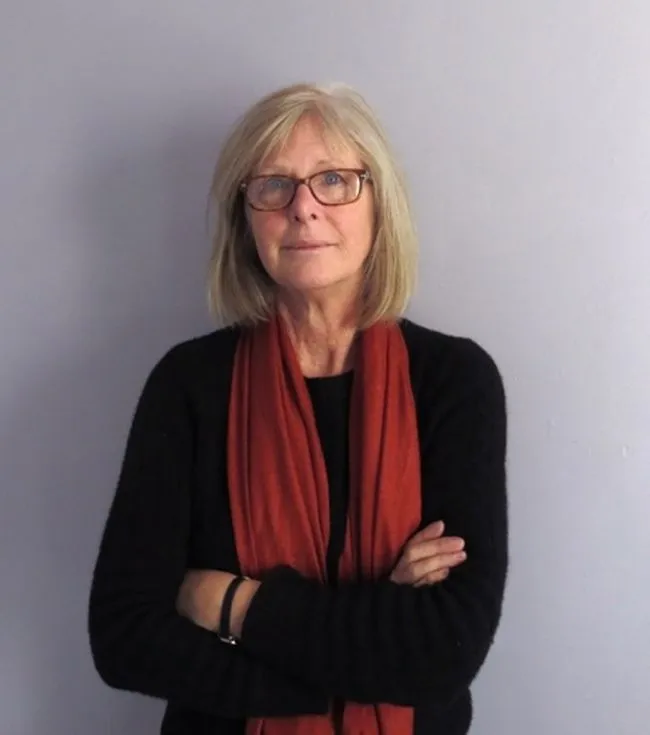
So I was not surprised when I read Maureen Garvie’s most recent book, Withdrawn from Circulation, a mystery novel whose main character is Greer McCallister, a senior librarian at Kingston Frontenac Public Library’s main branch on Johnson Street. Quiet, self-effacing Greer, who feels responsible for all the bad things that happen around her. Including murder.
Garvie is well known to Kingston readers. She’s written three previous books, including two novels for young readers — Lake Rules and Amy by Any Other Name, and a nonfiction book, George Johnson’s War, which Quill & Quire called “an accomplished work of historical ‘faction.’ Maureen co-authored the book with Mary Beaty, the former head of children’s services at the Kingston Frontenac Public Library.
Maureen herself is a trained librarian. Born in Kingston, she has degrees in teaching and in library science. The novel is filled with insider library knowledge, not only the day-to-day routines but the way librarians think in terms of cataloguing experience, assigning categories and even possible Dewey Decimal designations. Maureen moved to New Zealand, where for 12 years she worked on various farms and in various libraries, returning to Kingston in 1983. She worked as an editor at the Whig-Standard for a time, when the paper was still owned by the Davies family, and now teaches writing and editing at Queen’s University.
Withdrawn from Circulation is her first adult novel.
“It’s a bit of a poseur as a mystery,” she says, by which she means that when she started writing it several years ago she didn’t think of it as a mystery at all. It was a novel about Greer McCallister, a 39-year-old senior librarian at the Canterbury Public Library in Christchurch, New Zealand, where Maureen worked while living abroad. (The setting has been changed to KFPL’s main branch.) Greer is undergoing a crisis in her life, not unlike the crises many 40-year-olds go through. She has left her husband of 20 years, is living alone and loving it, spending her evenings reading and thinking, wondering why she hadn’t made this break for freedom ages ago.
But then her life becomes tangled. She has an unsatisfactory love affair, gets tired of explaining her actions to her husband and her mother and her colleagues at the library. She has an unfortunate accident with her car. The novel becomes interestingly complex and real.
“But the thing never gelled,” Maureen says. “It never had enough gravitas.”
So the novel-in-progress languished, becoming “one of many manuscripts I’d been dragging around for decades.”
Then, in 2013, Maureen took the novel with her to the Sage Hill Writing Experience, the famous writers’ retreat in Saskatchewan’s luscious Qu’Appelle Valley, where for two weeks that July she worked on the book under the tutelage of Kingston novelist Helen Humphries. Helen told her the novel was “fine,” but suggested she try working on something new, “instead of dragging around corpses.”
Maybe it was the word “corpses” that gave Maureen the idea of turning the book into a mystery.
“I’d been reading a constant stream of mysteries,” she says, and indeed, in the novel Greer is often curled up on her sofa with Inspector Morse or Agatha Christie, or watching Lewis on television. “And one day I thought, well, if I just killed off a character, that would give the novel some gravitas.”
There’s nothing like a dead body to give a novel gravitas.
“I spent an enjoyable period deciding who to kill, and then cut out about half of the old book, and the result is Withdrawn from Circulation.”
It is a highly believable murder mystery, with a satisfying number of plots and subplots, most of which involve Greer, and an amiable but persistent Sergeant Pereira, who traces an alarming number of the threads in the case to Greer. Her colleagues at the library are a motley crew of seasoned librarians with complicated private lives — two of them are writers in their spare time, and one is a widower with a shadowy past — and younger recruits whose lives outside the library are intriguingly inscrutable. The children’s librarian, a single mother named Bronwyn, is not modeled on Mary Beaty, Maureen acknowledges, but rather on the children’s librarian at the Canterbury Public Library in New Zealand, who “often stayed up late writing marvelous children’s books and caught up on her sleep the next day in the library stacks.”
Kingston readers will enjoy the local references. Librarians and the Kingston writing community seem to spend a lot of after-hours time in the Canoe Club at the Prince George Hotel. At Christmas, Greer attends a choral performance at St. Bartholemew’s Cathedral, a thinly disguised St. George’s. Some of the references will raise eyebrows. For example, when the body in question is found one morning in the parking lot of the Central Library, my first thought was that the parking lot at the Central Library isn’t big enough to hold a body.
Withdrawn from Circulation is a compelling mystery, but it is also a wonderful novel in its own right. The murder might tie all the threads together at the end, but it is a delight to just follow the intrigues with Greer’s mind. It’s the third book to be published by the small Kingston press, Cowdy House, run by Christina Decarie and Darryl Berger, and where Maureen has worked as an editor. It’s being released as both a paper book and an ebook,
The library pun in the title will bring to mind a string of possible future sequels. Is it too much to suggest that this debut mystery from Maureen Garvie is long overdue?
Ted Barris
The Reach to Write

The reach to write
By Ted Barris – July 26th, 2011
Whenever I talk with writers, there are plenty of taboos. They don’t often speak about how much money they make. Not many writers will divulge the nature of any publishing contracts they’re negotiating. And some are even superstitious about not revealing either the title or the content of a new book they’re working on. But you can always tell a group of writers is really getting into a heavy discussion when one warns:
“No, no. Don’t use the ‘M’ word!”
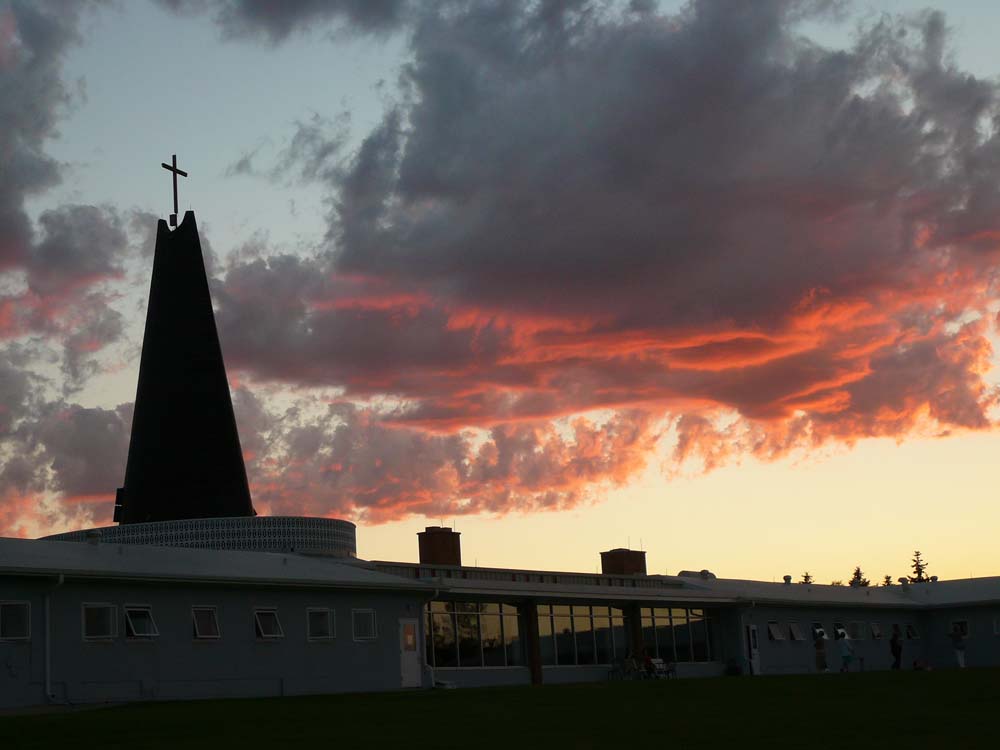
A spiritual experience for some, the Sage Hill Writing Experience
takes place each year at St. Michael’s monastery at Lumsden, Sask.
‘M’ stands for metaphor. And, of course, a metaphor – a figure of speech in which there’s an implied comparison between two different things – is a handy tool in nearly every kind of writing. Political satirists might compare politicians to a horse’s ass. Novelists may use the layers of an onion to illustrate the way of revealing character. Or poets – they’re most guilty – use metaphors all the time, comparing birth to light, death to darkness and life the abyss in between.
This week, as I did last year, I led a mid-summer, non-fiction writers’ workshop at a monastery in the Qu’Appelle Valley north of Regina, Sask. The Sage Hill Writing Experience allowed me to work with four writers attempting to get their planned manuscripts closer to book status.
The appropriate metaphor here might be getting their creations “closer to being born.”
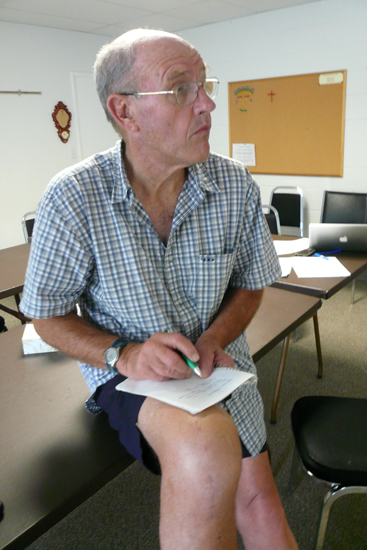
Except that one of my four writers, named Jerry Haigh, is not a woman; he has, however, metaphorically given birth to three previous books. Drawing from his worldwide experiences as a wildlife veterinarian (based at the University of Saskatchewan), he has been “Wrestling With Rhinos,” learned “The Trouble with Lions,” and discovered the essence “Of Moose and Men.” Clearly a man with little or no fear of large creatures, Dr. Haigh faces perhaps his greatest wildlife challenge (and most daunting metaphor) in his next book (the one we worked on this week) about the physical, environmental, political and mythological state of the world’s polar bear population.
Published author, Dr. Jerry Haigh,
now has a project for global readership.
“Polar bears,” Dr. Haigh pointed out, “are the current ‘poster child’ for issues ranging from conservation to climate change and the perilous state of the Arctic.”
Another of my writing colleagues this week, Jean Crozier, has succeeded in everything she’s touched in her professional life. She ran a successful library and information management company in Alberta for 20 years. She has self-published a two-volume family memoir, called “No Corner Boys Here.” An Alberta magazine even chose her among the “Fifty Most Influential People” in the province. But her greatest victory, navigating her way “Through Widowhood,” she feels, can only be accomplished by publishing the story of her husband’s premature death and her own ability to cope.
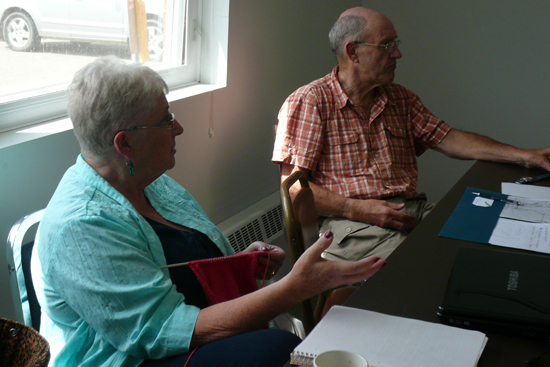
Jean Crozier, foreground, has a unique
passage through widowhood to tell.
“No one else can feel the death knife…” she wrote.
In contrast, a schoolteacher from Prince Albert, Sask., has perhaps the greatest and worst story to tell. The trauma faced by one member of Evonne Garnett’s family leaves no room for metaphor. The abuse that members of her family inflicted on one other, goes back to its roots in Russia, migrates to the Canadian Prairies in the guise of duty, and slips through the cracks of every social safety net imaginable. Diary tales of rape, paedophilia and being a prisoner in the attic, would have a reader expect only death and a funeral in the last chapter.
Evonne Garnett, left, and Ayelet Tsabari in a
non-fiction workshop.
“[But] with only the aid of her journals and her faith,” Garnett writes, “she broke free of the abuse cycle to find a measure of peace and freedom.”
Freedom never seemed a problem for Ayelet Tsabari, the fourth writer in my group. Born and raised in Israel by her Yemeni parents, Tsabari left her comfortable home there to travel and search. Her current memoir, what she calls “a suite of essays,” explores her own travels as a woman apparently unable to settle in one place. She too has found a comfortable home in metaphor, for, in one instance, she uses her short time “joining” the Israeli Defence Force to make her point.
“Saying I ‘joined’ the IDF makes it sound as if I did it on a whim, like taking up tap-dance lessons,” she writes.
Service was mandatory, boring and unpleasant; at one point she was accused of stealing weapons. Exonerated in a zany scene involving a lie detector, she soon moved on, eventually to Canada, to marriage and a string of awards for her writing.
I hold great hope for my four creative colleagues. Unlike the writers I described at the beginning – afraid to deal with taboos – these successful authors-in-the-making have been fearless and honest with themselves and each other. Last night, as a number of us gathered to gaze at a Prairie night sky bursting with stars, one last impression – yes, a metaphor from Robert Browning – came to mind.
“One’s reach should exceed one’s grasp, else what’s a heaven for?”